
The Family Forest Carbon Program

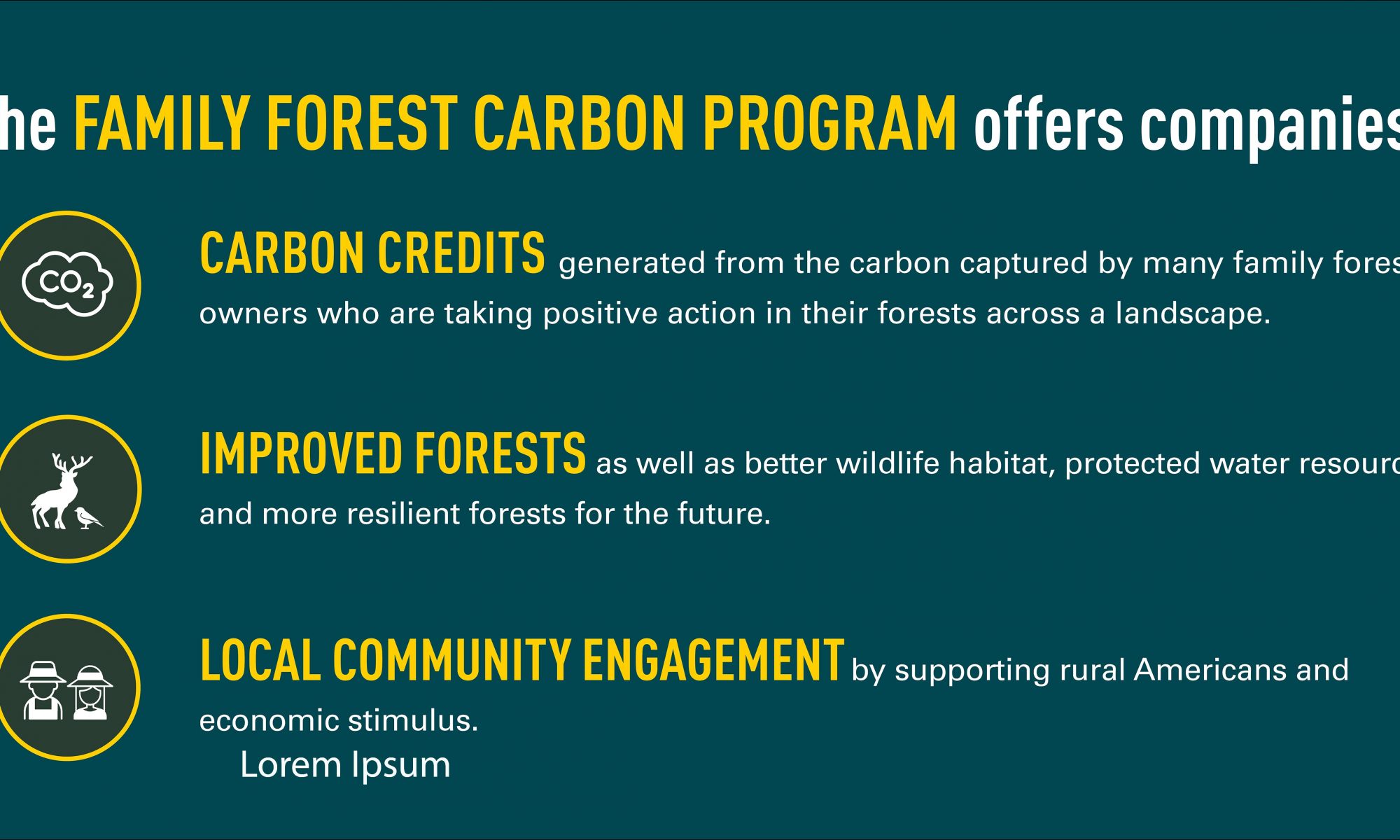
The Family Forest Carbon Program is a new program, created by the American Forest Foundation and The Nature Conservancy, that brings together rural family forest owners and companies to address climate change together.

In the U.S., families, and individuals own the largest portion – 36% – of all forests. Yet nearly all of these owners have been unable to access carbon markets due to high upfront costs and complexity. The Family Forest Carbon Program helps solve this challenge, giving family forest owners an opportunity to bring in income from their land, in exchange for implementing sustainable forest practices that help sequester and store more carbon. Companies in turn can purchase this carbon in the form of verified carbon credits.

Carbon produced from the small landowner holdings enrolled in the Program will be available for purchase in the form of verified carbon credits. For companies, this provides a method for reducing residual emissions when energy efficiency, renewable energy, and employee behavior change strategies have all been exhausted.
Climate Change Increasing Flooding Risk

The climate models predict ocean level rise and increased rainfall events with significant flooding. First Street Foundation published a study this week showing that nearly 70 percent more homes are at substantial risk of flooding than are within the Federal Emergency Management Agency’s Special Flood Hazard Areas, a designation that determines eligibility for the National Flood Insurance Program.

Read the full report here:

https://assets.firststreet.org/uploads/2020/06/first_street_foundation__first_national_flood_risk_assessment.pdf

Keeping Mature Forests Intact Is Key to the Climate Fight

Drs. Moomaw, Masino, and Faison coined the term “proforestation” in a 2019 paper. They say that keeping existing forests intact and growing them to their ecological potential is a more effective, immediate, and low-cost approach that could be mobilized across suitable forests of all types. They conclude that proforestation serves the greatest public good by maximizing co-benefits such as nature-based biological carbon sequestration and unparalleled ecosystem services such as biodiversity enhancement, water and air quality, flood and erosion control, public health benefits, low impact recreation, and scenic beauty.

 Forests annually sequester large quantities of atmospheric carbon dioxide (CO2), and store carbon above and below ground for long periods of time. Intact forests—largely free from human intervention except primarily for trails and hazard removals—are the most carbon-dense and biodiverse terrestrial ecosystems, with additional benefits to society and the economy.

Read the full paper here: https://www.frontiersin.org/articles/10.3389/ffgc.2019.00027/full

Read the interview with Dr. Moomar by Yale 360: https://e360.yale.edu/features/why-keeping-mature-forests-intact-is-key-to-the-climate-fight

Sleeping Bear Tree Farm Participates in Minnesota CO2 Study

A recent study by the USDA Forest Servce (https://www.nrs.fs.fed.us/pubs/59852) estimates that US forests represent the largest net carbon sink in the United States. They offset more that 11 percent of total green house gas emissions annually.

From the University of Minnesota :

Trees and climate change

Trees are a natural climate solution, absorbing carbon from the atmosphere and storing it as wood. This means that healthy growing trees increase carbon sequestration and help offset greenhouse gas emissions. 

According to recent estimates in the United States, forests remove about 11% of total carbon dioxide (CO2) emissions from the atmosphere. This is a motivation for keeping healthy trees and forests on the landscape! Minnesota woodland owners own 40% of the state’s forests or about 6.8 million acres.

The American Forest Foundation estimates that across all forest ownerships, private woodland owners have the greatest opportunity to mitigate the effects of future climate change through storing and sequestering carbon in their trees and woodlands.

In Minnesota this is especially true: our diverse forests from the North Woods in northern Minnesota to the Blufflands in southeastern Minnesota present a rich opportunity to contribute to natural climate solutions.

The Sleeping Bear Tree Farm will participate in current and future CO2 studies.

New IPCC climate report: Massive change is already here

The IPCC released a report today stating that climate change is having a staggering effect on our oceans and ice-covered areas of the earth. More than 100 scientists from around the world contributed to the latest report by the IPCC, which found that profound and potentially devastating consequences lie ahead for marine life, Arctic ecosystems and entire human societies if climate change continues unabated. Read the report here: https://www.ipcc.ch/srocc/home/

“As a result of excess greenhouse gases in the atmosphere, the ocean today is higher, warmer, more acidic, less productive and holds less oxygen,” said Jane Lubchenco, a former administrator of the National Oceanic and Atmospheric Administration (NOAA). “The conclusion is inescapable: The impacts of climate change on the ocean are well underway. Unless we take very serious action very soon, these impacts will get worse — much, much worse.”

“The climate emergency is a race we are losing — but it is a race we can win if we change our ways now,” U.N. Secretary General António Guterres told world leaders Tuesday in his latest attempt to spur action. “Even our language has to adapt: What once was called ‘climate change’ is now truly a ‘climate crisis.’ … We are seeing unprecedented temperatures, unrelenting storms and undeniable science.”

Read the Washington Post Summary here: https://www.washingtonpost.com/climate-environment/2019/09/25/new-un-climate-report-massive-change-already-here-worlds-oceans-frozen-regions/

What is this IPCC that Greta Thunberg is talking about?

You have likely seen Greta Thunberg on TV or the internet this week. She testified before the US Congress and the United Nations. She is remarkably consistent in referring policy and law makers to an IPCC report.

First, who is the IPCC? The Intergovernmental Panel on Climate Change (IPCC) is the United Nations body for assessing the science related to climate change. The IPCC was created to provide policymakers with regular scientific assessments on climate change, its implications and potential future risks, as well as to put forward adaptation and mitigation options.

The report that Ms. Thunberg references can be found here: https://www.ipcc.ch/site/assets/uploads/sites/2/2019/05/SR15_SPM_version_report_LR.pdf

The 2018 report is a comprehensive summary of the science behind climate change, potential impacts and an assessment of the risks.

I encourage you to read the summary and see why Ms. Thunberg is pleading with policy and law makers to read the report.

100 million tons a day vs 4,000 tons a year

The Sleeping Bear Tree Farm captures approximately 4,000 metric tons of carbon dioxide a year. That seems like a lot of carbon until you know that world-wide, 100,000,000 tons of man-made green-house gases are released every day.

Trees are very good at carbon capture. An average tree captures over 40 pounds of carbon dioxide a day. Scientists are now saying that planting trees can be part of the climate crisis solution, but creation of man-made green-house gases must stop.

Use your voice. Use your vote. Take action.

If Climate Change is so urgent, why is it not on the front page of the paper?

It is. This week there are multiple front page stories:

The Amazon, Siberia, Indonesia: A world of fire https://www.nytimes.com/2019/08/28/climate/fire-amazon-africa-siberia-worldwide.html

EPA to Roll Back Regulations on Methane, a Potent Greenhouse Gas https://www.nytimes.com/2019/08/29/climate/epa-methane-greenhouse-gas.html

Trump pushes to allow new logging in Alaska’s Tongass National Forest https://www.washingtonpost.com/climate-environment/trump-pushes-to-allow-new-logging-in-alaskas-tongass-national-forest/2019/08/27/b4ca78d6-c832-11e9-be05-f76ac4ec618c_story.html